A.M. Lukas on HBO’s The Chair and the Cost of Sexism in Film
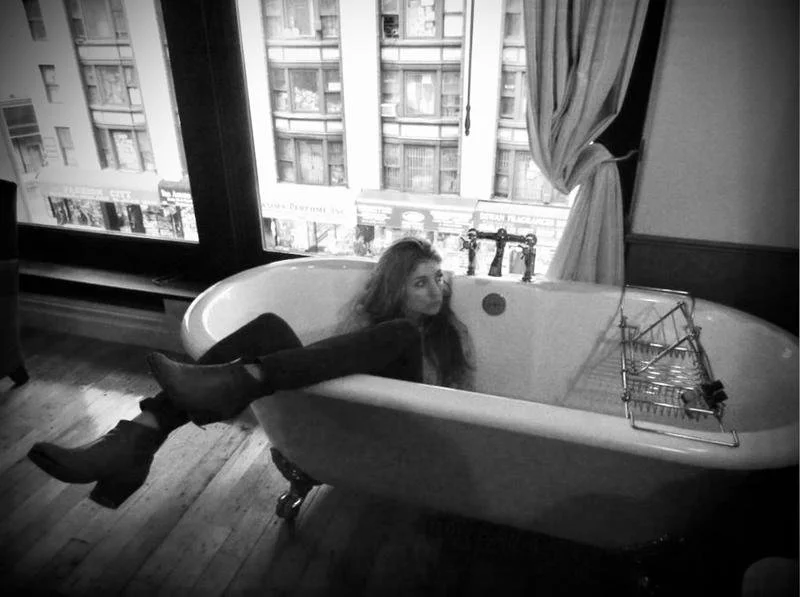
A.M. Lukas
The first time I saw A.M. Lukas, they were also on a screen. A contestant opposite controversial YouTuber Shane Dawson in HBO’s questionable docuseries The Chair. The series documented the directorial debut of Lukas’s first feature-length film, Hollidaysburg. At the time, Lukas was a young woman with a different name and a spark in her eyes that seemed incapable of extinguishing.
The person I saw before me had that same glint, but there was a weight behind the gaze. A steady knowledge that, at the time of filming the series, hadn’t quite been discovered yet. As I collected my notes, preparing to dive deep into Lukas’ past, I wondered for the millionth time if this was something she wanted to revisit at all. The series felt like a catalyst for a larger change in Lukas’ life.
And rewatching it felt like a pivotal shift in mine. I first watched the show as a fan of Dawson’s and, unsurprisingly, as a minor. In a show that paints him with the most horrid colors, my idolizing eyes only saw the best. Now, eleven years later, all I can see is the unsubtle and constant sexism Lukas faced. And I wanted to know more.
“[The show] revealed to me not only such deep sexism within the industry, but also in my own life,” Lukas says, the rawness of the confession taking me by surprise. “That experience of being on The Chair set into motion a really life-changing series of events. The stress of spending an entire year with very little sleep and working at the pace that I was working, to write and then direct and then edit and then promote a feature film while being filmed for a reality show.”
She smiles a bit at the absurdity.
“Like…you can hear the amount of work there.” Lukas says with a laugh, “The fact that my support system, my family, and my partner were all embedded into it.”
At thirty-two years old, Lukas had already made a name for herself in the indie film scene. She was a reputable writer and had ample experience directing in a duo with her at-the-time husband. She’d just been itching to tell a story all on her own. Enter HBO’s 2014 show, The Chair.
A competitive docuseries that followed two directors adapting the same script from rewrite to premiere day, awarding $250,000 to the filmmaker who sells the most tickets. This was exactly what Lukas had been looking for. A fair chance at pursuing her dreams with a little financial backing. Lukas entered the project bright-eyed and bushy-tailed, an optimist ready to take the world by storm. Naturally, things could only go downhill from there.
Even as a viewer, the sexism was apparent. Dawson was treated with the utmost respect, despite the many tantrums he threw on set. Meanwhile, before filming had even begun, Lukas fell victim to a narrative that she was an inexperienced and uncertain director. Like many women, she was constantly undermined, criticized, or condescended to by the male-dominated (honestly, I think male-only) team–and that was just the start.
“There was a certain writer involved in that show, and from the beginning, there was a gaze that was happening,” Lukas explains. “It's so hard to describe, but I knew this guy hates me in a very gender-specific way. In a way that he hates all feminine women.” That initial feeling would prove to be correct when, to the shock of many television viewers, the writer physically removed himself from Lukas’ set mere days into filming.
The issue seemed to arise early in the rewriting process. Both directors had received a script written by this man, and both directors were allowed to change as much as they wanted in order to make the film authentic to them. No one did so more than Dawson, who injected a smorgasbord of cancelable material into his script, rewriting entire characters and plot points. Lukas took a more subdued approach, adding levels of nuance inspired by her own life experiences.
“It was so deeply personal, which is why everything that happened was so crazy.” Lukas explains, “I just wrote my high school experience. I thought, ‘What was being 19 like? And who did I know? Who were the characters in my life?’ And I just channeled it all.”
After the rewrites, both directors were supposed to be joined by a team of producers, crew, and the writer to act as a sounding board throughout the filming process. But the writer only wanted to join Dawson, explaining that he didn’t write any of Lukas’ script.
“I have no involvement; I should not be on her set,” He stated in a heated discussion during The Chair. “I am choosing to leave Pittsburgh as soon as Shane’s movie wraps.” From then on, the writer ceased most communication with Lukas.
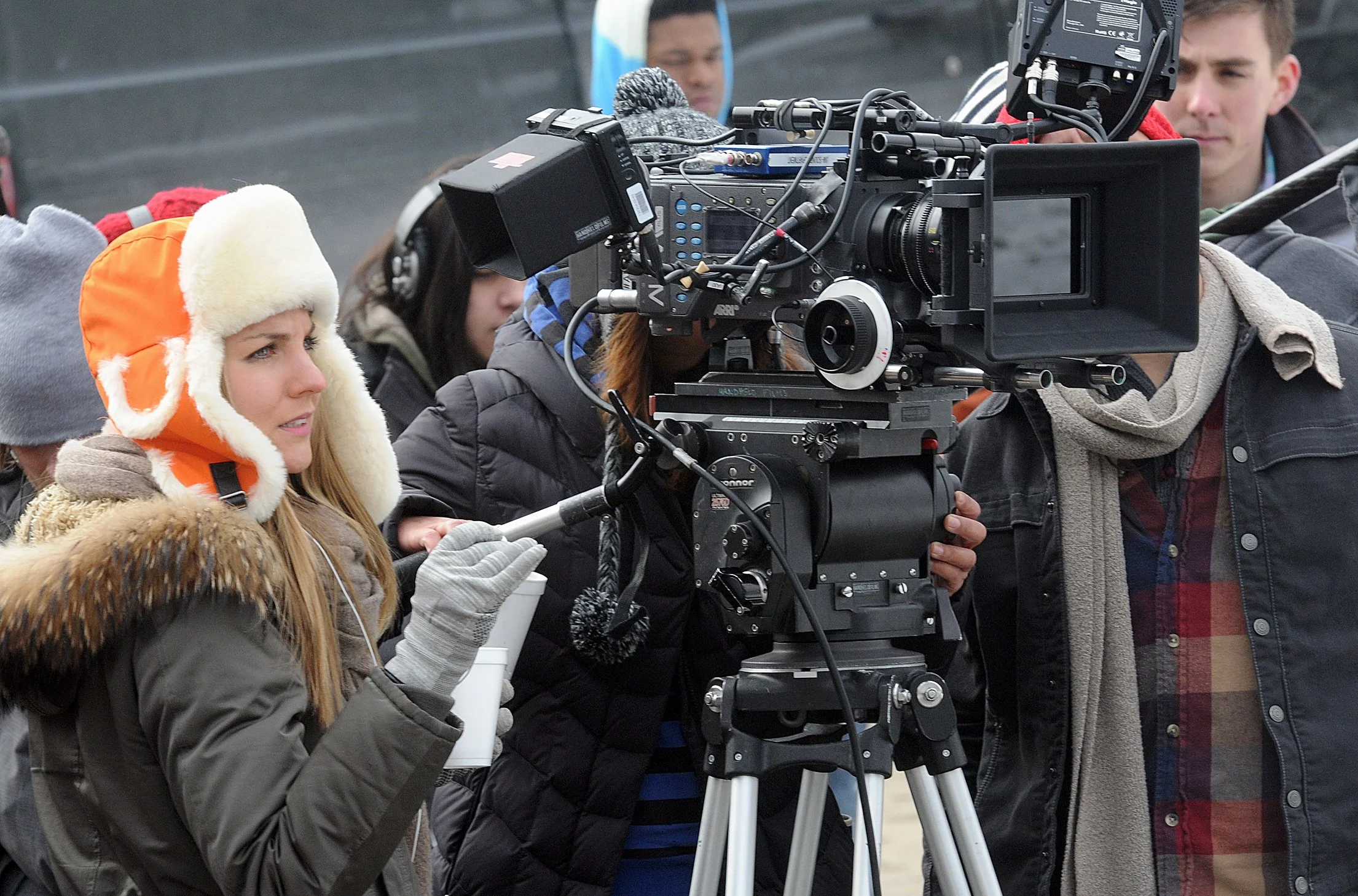
A.M. Lukas directing Hollidaysburg during The Chair.
Things escalated further as the film drew to a close.
“When it came time to decide who was getting writing credit on the movie, the original writer got a lawyer and said, ‘I want sole credit,’” Lukas explains, “Despite the fact that he very much didn't write what ended up being the movie that we put out.”
This was a complete turnaround from what the scriptwriter had voiced only a few months prior. His insistence on having sole credit shook Lukas to her core, “I wrote to him and said I will forfeit whatever money,” Lukas’s face pains at the memory. Ultimately, the writer stonewalled her, claiming his lawyers advised against it.
“At the premiere party, he invited his massive family, and they were all so proud. He had the gall to come up to me and say, ‘The movie really turned out well. It's really what I wanted it to be.’” Lukas says, the shock of the moment still written on her face.
In the end, the Writers’ Guild of America, a group of, at the time only white men, ruled in the scriptwriter’s favor. Lukas ended up losing writing credit entirely for a film that revolved primarily around her own life. Lukas calls this period a “loss of innocence”.
“It was like a veil being pulled from my eyes. ”
“I had an idea of equality. I was raised with notions that you're allowed to pursue whatever you want. You can go to university. You can do whatever the boys do. I'm really grateful I had that instilled in me.
“It was like this great thing that they were raising us kids with in the '80s, I guess.” Lukas laughs, “But it made that realization, it made the truth a really difficult pill to swallow.”
When the series finally aired, Dawson, who’d come into the project with 12 million subscribers, won in a landslide. He got to walk away with $250,000, while Lukas walked away with nothing.
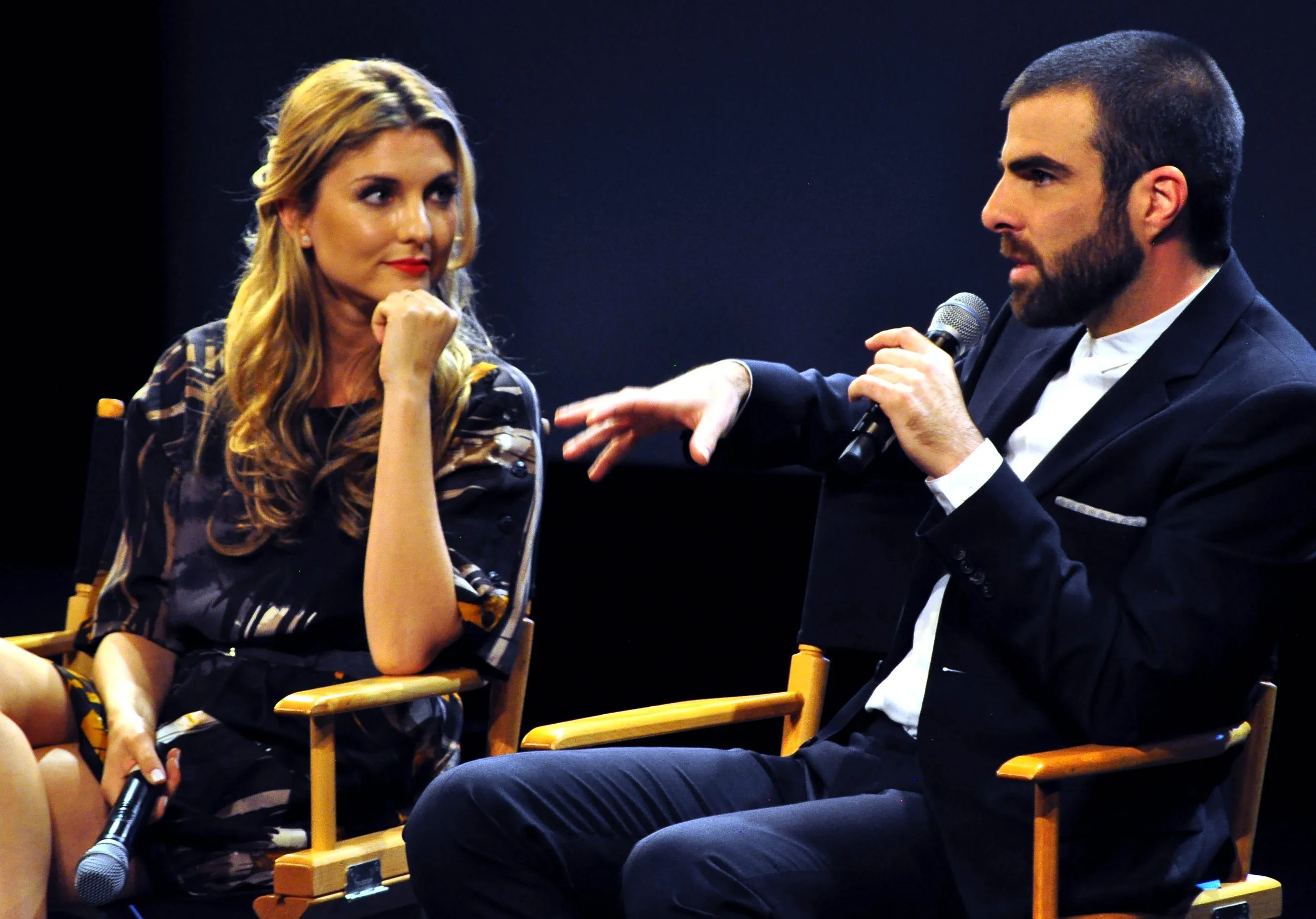
A.M. Lukas with famed actor and The Chair producer Zachary Quinto at the NYTV Fest Panel. After watching a rough edit, Quinto decided to remove his name from the credits of Dawson’s film stating, “I’ll never get the two hours I spent watching Shane’s movie back.”
Lukas considers the series a turning point that led to what she affectionately refers to as “a mental health cascade implosion”. In the show's aftermath, Lukas’s wellbeing took a turn for the worse as she experienced a total ego death. The series had highlighted the level of sexism that existed in her personal life, resulting in a divorce. As Lukas began reconstructing her identity as an artist and a person, she stripped everything down to the floorboards. Walking away from old habits, values, and even her name entirely.
“I wanted to choose my own name. I didn't want my dad's name anymore. There was a lot of gender stuff,” Lukas begins, opening up for the first time about her identity, “There's a big part of me that doesn't feel completely of the gender that I look on the outside.”
While some parts of this existed well before Lukas entered the industry, the sexism within it seemed to exacerbate this feeling: “I think a lot of it was tied up with being a writer and feeling like I was never gonna get taken seriously because I was perceived as a girl and a girly girl.” At times, Lukas felt as if she was portraying a character, giving into the idea people had of who she should be.
Changing her name was a step in the right direction, “It felt like I was reclaiming who I was. Anna Martemucci is captured forever in her ‘before-state' on that show.” Lukas laughs, “I took my mom's name, because I was like, that only makes sense. After half my life with my dad's last name [to have] half my life with my mom's last name. And I chose it, and I like it.”
As I observe Lukas through the screen, leaning on a couch, lounging a world away in beautiful Italy, she seems more than content with the life she’s living and the way things shook out. And as for gender identity? “I'm letting it be a question,” Lukas says with a smile, and an ease her younger self could only aspire to hold.
Since The Chair, Lukas has continued her successful career in the film industry, debuting her short film One Cambodian Family Please for My Pleasure as part of TNT’s Shatterbox series in 2018. Lukas laughs when recalling just how different that set felt from HBO’s series, “It was like the feminist, magical, gender parody version of The Chair,” Lukas explains, “Shatterbox, it was Refinery29 at the time, sent a camera crew just to do a regular behind-the-scenes. To document in a positive way. Not trying to cause drama or figure out that really my husband was directing the whole thing the whole time. It was none of that. It was just lovely.”
The short was written and directed by Lukas, who has kept sole writer’s credit over the project. Inspired by her mother's own life, the film follows a Czech refugee in her new hometown of Fargo, North Dakota. One Cambodian Family keeps Lukas’s signature heartfelt, humorous tone, combining laughable one-liners with gut-punching vulnerability.
“It happened to be all women producers, and Emily Mortimer.” The lead actress, “She got involved because she just liked that 12-page script. She fell for it, and she said this level of writing needs to be put on screen, and I will make it happen.” The short was nominated for awards in the Sundance Film Festival and London Film Week. Lukas later even sold the film to Showtime to be adapted into a series.
Since the Paramount and Showtime merger, the project has been stuck in limbo—a familiar story in the film world. For Lukas, it’s nothing new; she’s already pivoting to other projects as she rides out the industry’s waves.
A.M. Lukas on the set of One Cambodian Family Please for My Pleasure.
Upon my request, she offers this sage advice to any female-presenting individuals looking to make it in the film industry: keep your eyes open. “Being aware is good. I think there's a lot more awareness now. And people like you are making that more and more true for women and anybody who's not basically a rich white man to have a clear-eyed view of what they're entering.
“It's a deeply disturbing microenvironment that is allowed to thrive with deep injustice at its core. There's childhood sexual abuse that's totally unaddressed. There are child working conditions that are totally unaddressed. And there are massive gender and racial and everything disparities.”
Lukas shared multiple instances of sexism she’s still facing to this day. It’s an ongoing issue, but being aware is the first step in not playing into the games of the industry. “One thing this business teaches you is to be good and quiet and don't be bitter and don't be negative, or you'll never work in this town again. I'm just so tired of adhering to those rules.” Lukas is deciding she simply won’t.
Even when the industry rears its ugly head, though, it never tamps down the passion Lukas has for her craft, “I love the fact that I've chosen something where it's a lifelong exploration into what it is to be human… I love that I get to ask the big questions and feel the big things, and that everything that I've experienced in my life, be it good or bad or rotten or wonderful, it all makes me a better writer. That's my favorite thing about it, that nothing is wasted.”
The entire conversation felt like a sigh of relief for both of us. As a former fan, I’d always wondered how Lukas felt about the series. Now, I knew. It was as it looked. Torturous and sexist, and yet, ultimately resulted in a project Lukas looks back fondly on. One she’s still proud of to this day. On her end, it almost felt like a therapy session. Delving deep into the past and finally, once and for all, leaving it where it belonged.
While A.M. Lukas is currently off social media, you can follow along on IMDb to stay up to date with her upcoming projects.